01
Assessment layer
Collects structured data on health, ageing, work limitations, role requirements and organisational priorities.

LifeCharger Atlas is our proprietary workforce health governance engine, helping companies understand how employee health, ageing and work limitations can affect productivity, absenteeism, work continuity and strategic workforce planning.
Headcount, absenteeism and turnover describe what is already visible. But they rarely show how health, ageing and work limitations may affect the workforce capacity needed to sustain performance over time.
Your workforce may remain stable in numbers while losing operational capacity.
Employee health is not only a welfare topic. It is a strategic factor that can influence productivity, service quality, continuity of skills and organisational resilience.
The real question is not only how many people are available today. It is which physical, cognitive and relational capacities are actually available to perform specific roles and tasks over time.
LifeCharger helps companies connect health-related information, workforce composition and role requirements to generate practical intelligence for HR, occupational health, HSE/RSPP and management.
Atlas connects assessment data, workforce capacity indicators, risk signals and intervention planning into a single decision layer for HR, occupational health, HSE/RSPP and management.
Collects structured data on health, ageing, work limitations, role requirements and organisational priorities.
Translates health-related information into physical, cognitive and relational capacity indicators.
Generates a synthetic view of workforce capacity sustainability to support planning, prevention and prioritisation.
Supports KPIs, intervention plans, stakeholder coordination, disability management and measurable outcomes.
LifeCharger connects workforce data, operational capacity and predictive indicators to help companies identify risk and activate targeted actions.
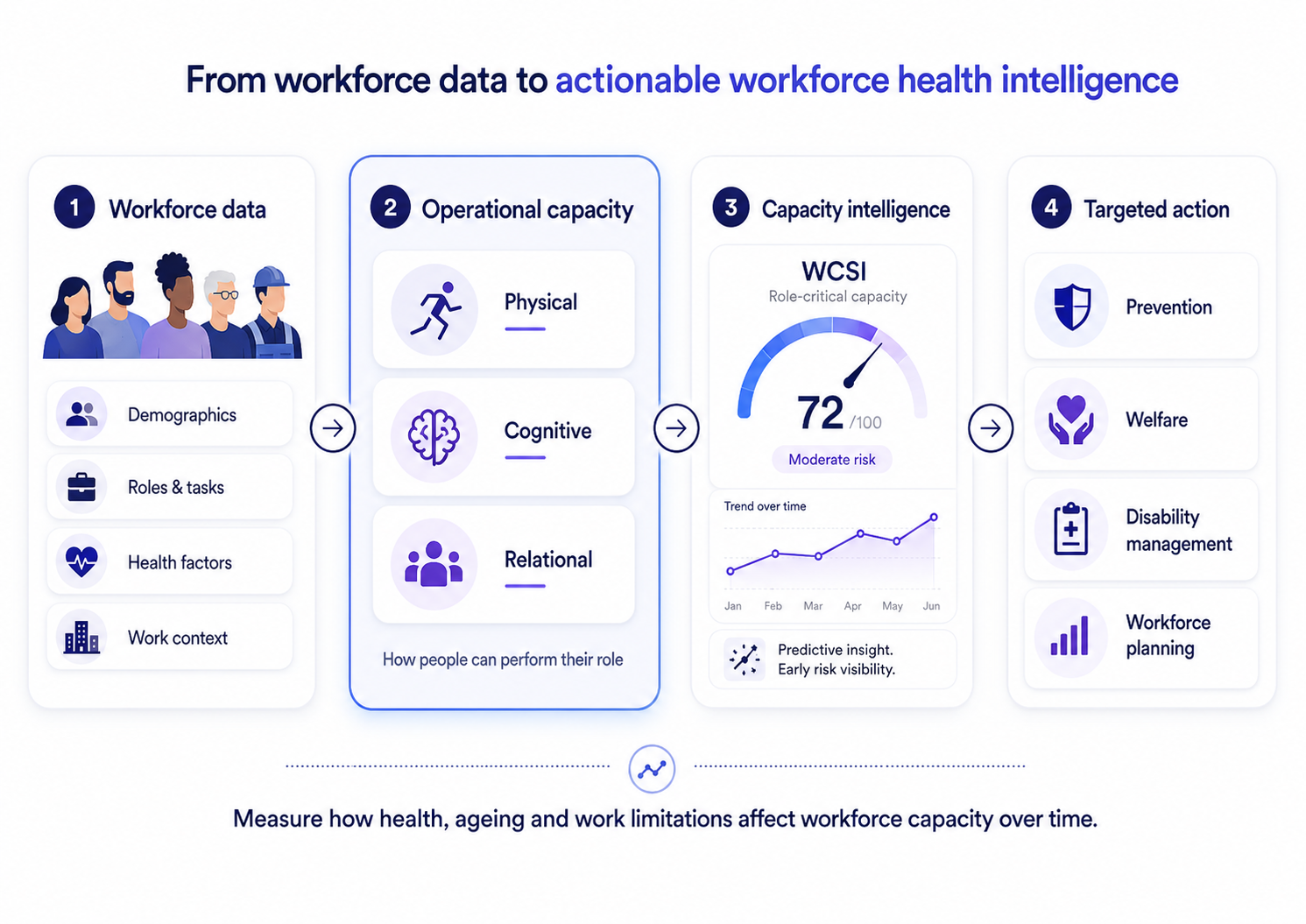
The model transforms demographic, role-based and health-related information into a clearer view of physical, cognitive and relational capacity, supporting prevention, welfare, disability management and strategic workforce planning.
The WCSI helps estimate how health, ageing, role requirements and work limitations may affect the operational capacity available to the organisation — supporting prevention priorities, workforce planning and measurable action through LifeCharger Atlas.
A focused set of reports, indicators, dashboards and recommendations to move from analysis to measurable action.
A structured assessment of workforce health-related risks, future scenarios, priority areas and recommended actions.
A synthetic indicator to monitor how operational capacity may evolve across the workforce, roles or business units.
A decision layer to manage KPIs, interventions, stakeholder collaboration and measurable outcomes.
Operational support for prevention, welfare, disability management and personalised work plans.
Companies can adopt Atlas progressively: from a focused assessment to ongoing governance, pilot implementation and operational support.
Define priorities, target population, critical roles and business questions with HR, occupational health, HSE/RSPP and management.
Analyse demographic, health-related, organisational and role-specific indicators to estimate potential capacity risks and future scenarios.
Deliver WCSI, role-critical risks, priority areas and recommendations. The company can stop here with a structured assessment.
Activate the governance platform to manage KPIs, intervention plans, stakeholder collaboration, pilot implementation and measurable outcomes.
For workers with disabilities, limitations or reduced work capacity, Atlas supports task-level analysis and personalised work planning to preserve inclusion, productivity and operational continuity.

A concrete application of LifeCharger Atlas for disability management was explored within a Proof of Concept with Rete Ferroviaria Italiana, focused on work limitations, role-task compatibility and personalised work planning.
The PoC addressed how digital tools can support HR, occupational physicians, HSE/RSPP and management teams in assessing limitations, analysing task compatibility and coordinating more structured decision-making.
Collect structured information on work limitations and functional capacity in a privacy-conscious way.
Compare job tasks and sub-tasks with physical, cognitive and relational requirements.
Support compatible tasks, work adjustments and personalised work plans for inclusion and continuity.
Track interventions, continuity, feasibility and measurable impact through the Atlas governance layer.
Begin with a strategic workshop and predictive assessment. Then decide whether to stop with the report or scale into LifeCharger Atlas for ongoing governance, pilot implementation and operational support.
Request a demo →